Home-Heat Options When a Full Cold Plunge Will Not Fit
When floor space, plumbing access, or budget rules out a full cold plunge setup, a home sauna is the strongest heat-based alternative, requiring no drain or water line and fitting in as little as 12 to 16 square feet for a compact infrared cabin. Saunas also carry more established research behind them than cold water immersion does, with decades of Finnish cohort studies linking regular sauna use to lower cardiovascular and all-cause mortality risk. A cold shower is the free fallback for anyone who still wants a cold-exposure component without the tub. Here’s how the heat-only options stack up against a full plunge setup, and what the evidence actually supports for each.
Why Consider Heat-Only When Space Is Tight?
A full cold plunge setup needs more than just the tub itself. Chiller units require electrical service, a drain for water changes, and enough clearance around the tub for someone to get in and out safely, which together often add up to 25 to 40 square feet once everything is accounted for. A compact sauna, especially an infrared cabin built for one or two people, can fit into 12 to 16 square feet and typically needs nothing more than a dedicated electrical circuit. For a garage corner, a small bathroom nook, or an apartment balcony, that difference in footprint and plumbing requirements is often what decides the question.
What Does the Evidence Actually Say About Sauna Bathing Alone?
This is where a heat-only setup has a real evidence advantage. A landmark study in JAMA Internal Medicine following Finnish men over roughly two decades found frequent sauna bathing associated with meaningfully lower rates of fatal cardiovascular events and all-cause mortality. A 2018 review in Mayo Clinic Proceedings summarizing this and other research described a consistent pattern across multiple cohort studies linking regular sauna use to better cardiovascular outcomes, reduced risk of neurocognitive decline, and improved respiratory function. These are observational associations, not randomized proof of causation, since people who sauna regularly may differ from those who don’t in other health habits too. Still, the consistency across multiple independent studies over many years gives sauna bathing alone a stronger evidence base than most single-component wellness purchases.
How Does That Compare to Cold Water Immersion’s Evidence?
Cold water immersion research is comparatively newer and more mixed. A 2025 systematic review and meta-analysis in PLoS One evaluating cold water immersion’s effects on health and wellbeing found genuine but modest support for mood and recovery perception, alongside limited evidence for the stronger physiological claims sometimes made about it. This isn’t a knock against cold plunging, but it does mean that for someone choosing between a sauna and a cold plunge purely on the strength of supporting research, sauna bathing currently has the deeper evidence base. A 2018 systematic review in Evidence-Based Complementary and Alternative Medicine reached a similar conclusion, describing consistent findings across studies on sauna’s cardiovascular and respiratory effects even while noting most of the underlying research comes from a single geographic and genetic population.
What Are the Realistic Heat-Only Options?
Infrared saunas use panels that heat the body directly rather than warming the surrounding air first, run at lower ambient temperatures around 120 to 140 degrees, and are generally the most compact and least power-hungry option. Traditional electric saunas heat the air itself to 150 to 195 degrees using a heating element and rocks, need slightly more electrical capacity, and deliver the more classic, intense sauna experience many people associate with the practice. Both fit in a fraction of the footprint a plunge setup needs and skip the plumbing question entirely, since neither requires a water source or drain.
Is a Cold Shower a Real Substitute for a Cold Plunge?
It’s a legitimate low-cost option for anyone who still wants some cold exposure without dedicated equipment, and it costs nothing beyond what’s already installed. The tradeoff is control. Most residential water heaters and plumbing systems can’t reliably produce water below the mid-50s even at the coldest setting, so a cold shower can’t replicate the 39 to 45 degree range some cold plunge users target. For someone specifically prioritizing heat therapy in a tight space, though, the shower question becomes secondary anyway, since the sauna is doing the main work.
Is a Small Cold Plunge Still an Option in a Tight Space?
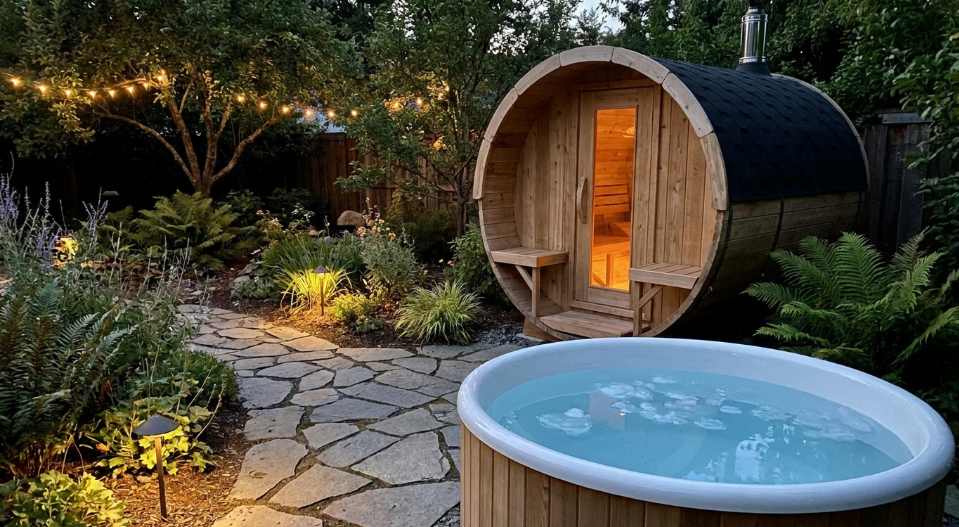
Before ruling out cold exposure entirely, it’s worth knowing that a scaled-down cold plunge does exist. A compact insert tub holding as little as 40 to 60 gallons, well under the 90 to 150 gallons a standard barrel-style unit holds, can fit in a corner as small as 3 by 3 feet with a simple plug-in chiller and no drain plumbing at all. Water changes have to happen more often at that smaller volume since there’s less water to dilute buildup between changes, typically every two to three weeks instead of every four to six for a full-size tub. For someone who wants both heat and cold in a tight footprint, a compact sauna paired with a small insert tub can sometimes fit where a single full-size cold plunge alone would not.
What Should You Budget for a Heat-Only Setup?
A compact one or two person infrared sauna typically runs $2,000 to $4,500 installed, noticeably less than most chiller-equipped cold plunge units and without the added electrical load a chiller compressor draws. Monthly running costs land around $15 to $30 for a few sessions a week, mostly electricity with no water treatment chemicals to budget for at all. Anyone comparing footprint, price, and features across ready-made sauna models before deciding can look at one specialty retailer that lists dimensions and power requirements side by side, which makes it easier to see what actually fits a given space before ordering.
Frequently Asked Questions
What’s a good alternative to a cold plunge in a small space?
A compact infrared or traditional sauna often fits in as little as 3 by 4 feet and has a fair amount of supporting long-term research on its own.
Is a sauna a reasonable substitute for a cold plunge?
They work differently, but sauna bathing alone has a stronger evidence base from decades of cohort research than cold water immersion currently does.
Can a cold shower replace a dedicated cold plunge?
It’s a reasonable low-cost substitute, though most home showers don’t get nearly as cold as a chilled tub and temperature is harder to control.
How much smaller is a compact sauna than a cold plunge setup?
A one or two person infrared sauna fits in roughly 12 to 16 square feet, versus 25 to 40 square feet for a full plunge setup with clearance.
Does a sauna require the same plumbing as a cold plunge?
No, most home saunas need only an electrical circuit, no water hookup or drain, which is why they fit spaces a plunge tub can’t.
References
- “Association between sauna bathing and fatal cardiovascular and all-cause mortality events.” JAMA Internal Medicine, 2015. https://pubmed.ncbi.nlm.nih.gov/25705824/
- “Cardiovascular and Other Health Benefits of Sauna Bathing: A Review of the Evidence.” Mayo Clinic Proceedings, 2018. https://pubmed.ncbi.nlm.nih.gov/30077204/
- “Clinical Effects of Regular Dry Sauna Bathing: A Systematic Review.” Evidence-Based Complementary and Alternative Medicine, 2018. https://pubmed.ncbi.nlm.nih.gov/29849692/
- “Effects of cold-water immersion on health and wellbeing: A systematic review and meta-analysis.” PLoS One, 2025. https://pubmed.ncbi.nlm.nih.gov/39879231/